

Our Programs
Toddler Communities (18 months to 3 years)
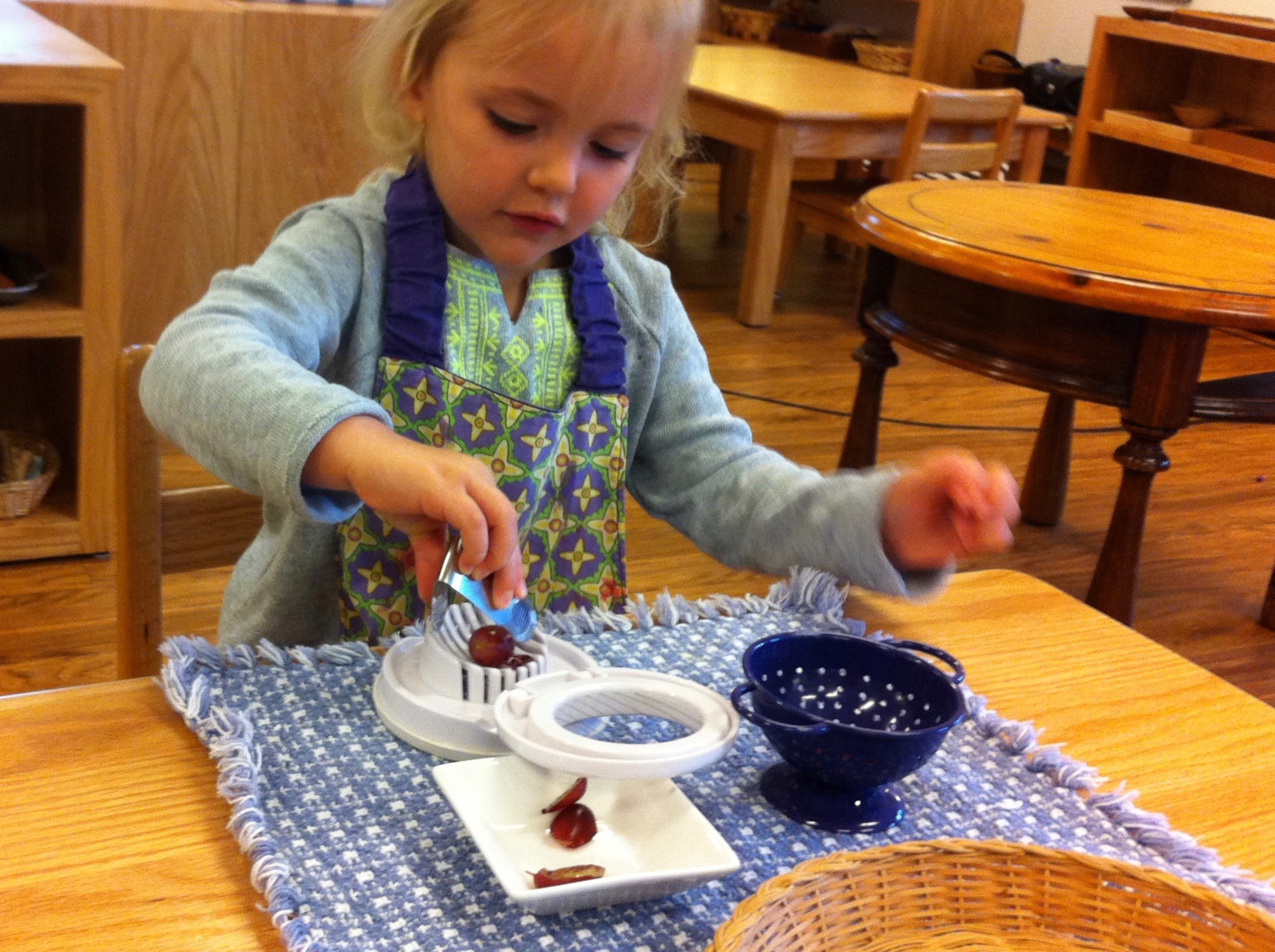
Children from eighteen months to three spend their days in one of three toddler communities located on the lower level of the Phoenix building. Each community has a large patio which opens onto a playscape with flower and vegetable gardens, an apple tree (from which the children and staff make their own applesauce and apple pies in the fall), a sandbox and a pathway for cycling. Toddlers love to work. Inside the children can be found arranging flowers in tiny vases to baking their own bread in addition to working with the many beautiful materials specially designed for them.
Read A Day in the Life of a Raintree Toddler
Children’s Houses (3 to 6 years)
Nearby are the Children’s Houses (primary classrooms) where children ages three to six pursue tasks of self-construction as they prepared their own snacks, feed classroom animals and get lessons from the teacher from hands-on academic materials which form the basis for a world class academic program in math, language, geography and much more including the lessons of Grace and Courtesy. How to serve a guest, close a door without making a sound, and introducing a friend are just some of the many lessons of daily living children receive.
Read A Day in the Life of a Raintree Primary Student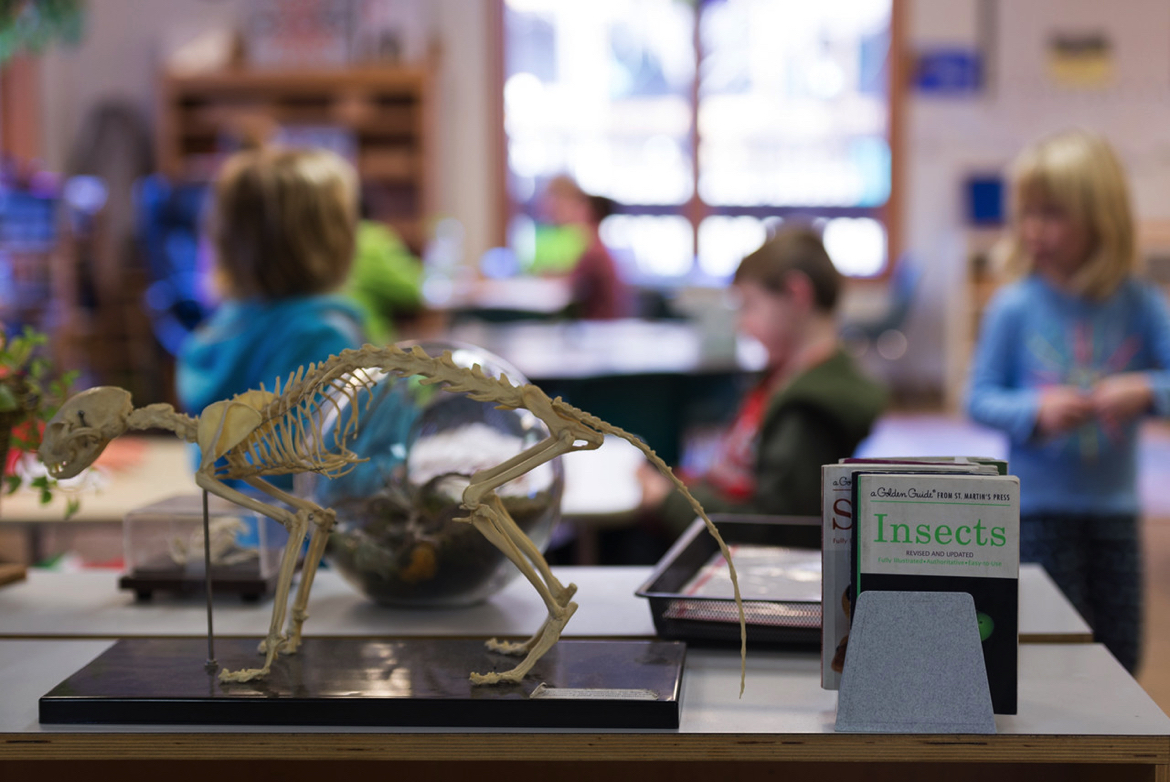
Elementary Classrooms (6 to 12 years)
The elementary program is housed in two buildings adjacent to the main building (Phoenix building) which have four lower elementary (ages 6-9) and four upper elementary (ages 9-12) classrooms. These mixed-aged learning communities are filled with hands-on academic materials unparalleled in other schools in the lower elementary moving toward abstraction of concepts in the upper elementary. The arts are integrated into the daily life of the classroom, and each classroom has a fully-equipped kitchen where children prepare their own food for classroom celebrations including baking their own birthday cake to share with their friends.
Read A Day in the Life of a Raintree Elementary Student
Erdkinder (12 to 14 years)
Our adolescent program, or Erdkinder, for students ages 12-14 is located on the third floor of the Phoenix building. The only program of its kind in the state, the Erdkinder classroom is a place filled with excitement—spirited political debates in the kitchen during food preparation, laughter at conjugating verbs in Spanish class, ah-ha moments in math seminar, and silence as the students do yoga sun salutations before morning meeting. These are the sounds of the Erdkinder’s thriving learning community, a place where students find support and guidance as they develop their academic strengths while discovering their unique potential.
Read A Day in the Life of a Raintree Erdkinder StudentA Day in the Life of a RaintreeToddler
As the day begins…
Give a warm and brief goodbye to your child at the door of the classroom or at the gate to the play yard. Encourage your child to give a handshake to the teacher. If the children are inside, understand that this time is part of the children’s uninterrupted work cycle. Te teacher will be giving individual lessons or working with small groups of children. Tis is not a time to have a lengthy discussion at the classroom door with the teacher or assistant as that would be disruptive to the children’s concentration.
Depending on the toddler community’s daily schedule, outside time is either at the beginning of the morning or the end of the morning. If it is a beautiful day the children may spend a longer period outside, perhaps bringing materials from the classroom to the outside patio to work or taking a long walk in the “Back 40” or exploring the primary or elementary playground. Te outside world is such a new place for the young toddler that we joyfully welcome novel adventures!
During the morning work time children are responsible for setting up their own snack place: tray, small water pitcher, glass, plate or bowl and cloth napkin. Each item is carried by the child one at a time to the space she chooses. When the child has finished, she is either offered snack by the teacher or she may help herself at the snack “buffet.” When she is satisfied and ready to get back to work, she cleans her space by putting away each material.
At every transition in the day, the children take the opportunity to use the toilet and wash hands. Tis happens when coming in from the outdoor environment, before snack, before lunch, after lunch, after nap, and again in the afternoon. It becomes part of the natural schedule of the day and therefore just part of what we do. Children are asked to sit on the toilet and wash hands. Child cubbies, a hamper and a drying rack are accessible to the children so that when a spill happens or clothing gets wet or soiled, the child can take care of himself independently or with assistance.
Developmentally toddlers are in the sensitive period for order, movement and language. The classroom environments are prepared to support these developmental periods in the young child. Toddlers need external order in order to develop their internal order. They need a large enough space for free movement inside and out. They need purposeful activities that encourage movement. The Montessori environment is rich with language – spoken language through conversation, song, storytelling, and materials that enrich their vocabulary. The world around the toddler is so interesting and wonderful that their is no need for baby talk or fantasy. Children want the accurate names of the interesting things they see around them.

Toddlers are developing their will which is a wonderful thing! You may hear, “No! I do it myself.” This is their path to independence and we need to support this natural development. An environment that is child-centered means that it supports the developmental needs of the child. Te furniture is toddler-sized and all the materials are accessible to the children. Children have freedom in the environment in which to choose what they wish to do.
The children eat lunch family-style in community serving themselves and passing dishes around the table. They clear all of their dishes: plate, utensils, glass, cloth napkin when finished and head to the restroom. The children use the bathroom, wash hands and brush teeth before finding their cot. Te transition from lunch to nap time is a natural procession and is child-driven. As more children are resting on their cots, the blinds are slowly closed, lights turned off and soft music turned on. The teachers assist children with gentle back-patting if needed.
As children begin to wake, lamps are turned on and blinds are opened. Children use the bathroom and help put their cot away. Depending on the schedule for each community, children may choose work, snack or prepare to go outside (or swimming) until parents pick-up.
A Day in the Life of a Raintree Primary Student
As the day begins…
Children arrive between 7:30 and 8:30 or in the case of an afternoon student, 11:30 or 1:00, joining their classmates either inside in the classroom or on the playground. If the class is inside, children are encouraged to hang up their own coat, change into their slippers and put away their own materials. The greeting process differs slightly in each classroom depending upon the daily schedule. Check with your child’s teacher regarding schedule and greeting procedure. In most classrooms, the day begins with a handshake so allow your child to enter independently if the teacher is not near the door when you arrive. One of the adults will greet your child, often with a handshake. This simple gesture not only reinforces a courtesy but is also a sign that your child is in our care.
If the children are in the classroom, you may fnd that your child’s teacher is giving a lesson. This is not a time to have a lengthy conversation with either the teacher or the assistant because their focus is on the children who are working in the classroom. If you have a question or comment keep it brief or jot down a note and place it in the teacher’s basket. The teacher will reply by phone or send an email later in the day.
During work time children move about the room freely choosing activities from the shelves that they are interested in and have had a lesson. They may work with the materials as long as they wish. Exploration and repetition are ways in which the children internalize the concepts.
The teacher plans lessons for each child based on the child’s readiness and interests. Through careful observation of the child at work, the teacher determines the appropriate time to give a lesson and what the lesson will be. Children are never interrupted when they are working by the teacher or the assistant, even to give a lesson; work time is sacred. Montessori’s famous quote, “Follow the child,” means that a teacher must be prepared to go in a completely different direction if the child shows more interest in another area of the classroom than what was originally planned.
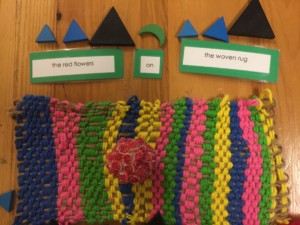 Because repetition leads to internalization, new lessons occur with regularity but not on a daily basis. As the child’s work repertoire increases and work cycles lengthen, his independence grows and his day is filled with work of their own choosing, often expanding beyond a basic lesson. For example, a child gets a lesson in measurement and decides to measure everything in the room! No teacher would stop such a wonderful challenge as the child goes about the room, ruler in hand, pencil and list at the ready, to record the findings. Dr. Montessori recognized the best time to learn is when interest is heightened and this is one advantage our classrooms offer.
The child’s reason for, and way of, working is different from ours. Adults will usually choose to do things the most efficient and quickest way and to rush through or avoid anything labeled “work.” A child, on the other hand, is working (subconsciously) to master the activity and to practice and perfect her abilities. She may scrub a table in the classroom every day for weeks, then turn her attention to some other activity to master. We must not look upon this method as inconsistency or laziness but rather cumulative mastery of abilities. The child’s purpose is not to complete the task as much as to construct the self. (Michael Olaf, The Child of the World).
Sometimes children are drawn to one area at the exclusion of others. The teachers can tell the difference between passionate exploration and “hiding out” in an area. Yes, children are allowed to pursue math lessons, for example, ad infnitum because the teacher knows that teachable moments especially those that come in streams are when the child is most receptive. A perfect metaphor would be how some people eat a plate of food. One will eat a little of each food item: a few bits of salad, then some of the main dish followed then by the vegetable, but others dive right in eating all the main dish, then the salad and fnish with the vegetables. The result is the same: a full tummy and in the Montessori class, a full day!
Snack is typically an individual activity meaning that during work time the child may choose to eat snack when she wishes. She may eat with a friend or two 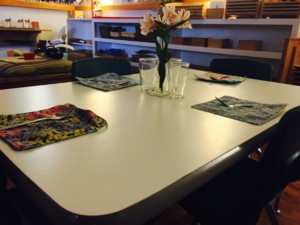 at the snack table. It is her responsibility to set up the things she needs and clean up when she is fnished which often includes washing her dishes, wiping her space at the table, sweeping under her chair and perhaps washing her cloth napkin. Everything that the children use in the classroom are real items whether it be glass, ceramic, or porcelain. In this way, children are respected and learn how to care for the beautiful items in their environment and experience the consequences when care is not given. “An adult works to perfect the environment, but a child works to perfect himself.” —Montessori
Outside time is either at the beginning of the morning or at the end. Check with your child’s teacher for the schedule. We go outside every day at Raintree unless it is raining, snowing or extremely hot or cold. It is important that your child has outerwear appropriate for outdoor play. As stated previously in this handbook, boots for gardening, hats/mittens and warm coats for cold weather, and sturdy, closed-toed shoes for the playground are essential for a child at Raintree. Montessori said, “There is no bad weather, only inappropriate clothing.” In the summer time the child’s outside time includes swim time.
Preparation for lunch is done by the children – setting tables with plates, glasses, cloth napkins, silverware and fowers. Children serve themselves either buffet style or family style. After lunch the children are responsible for cleaning up their own space.
In all-day classrooms, approximately half the children are nappers and go to the adjacent nap room and sleep on cots for about 1-1 1/2 hours while the resters roll out mats for resting on the foor listening to music or stories for about 30 minutes. Ten lights come on and children resume their work. When the nappers awake, they are invited to join their friends for afternoon work. Again, afternoon outside time is either at the beginning of the work cycle or at the end.
In a half-day classroom, transitions occur before lunch and after lunch as some children leave after their morning stay and afternoon children join their class. Work time and outside time (or swim) mimic the morning routine.
In a half-day class, some children depart at 3:30 while others continue into the late afternoon hours. Late afternoon is either an extension of the afternoon work time if the class went outside earlier in the afternoon, or it is a time to be outside. Later afternoon work may also include class preparation for the next day such as making a special snack, preparing food items for lunch the next day, or larger class jobs such as cleaning animal cages.
A Day in the Life of a Raintree Elementary Student
As the day begins…
Some students arrive early (7:30-8:15 AM). These early arrivers congregate on the playground where equipment is set up for their use. Early morning is also a perfect time to jog on the pathway or just visit with friends. In the winter, if it is too cold, students gather in the library.
At 8:15 the students go to their classrooms where they put away their personal belongings and join others who arrive at 8:15 to socialize before class begins. Socializing is important. That is why there is no charge for this 15-minute period. Arriving on time, or even a few minutes early, is an important life lesson and something that will serve the child well throughout her life.
At 8:30, the teacher begins morning announcements. Some days there are no announcements, and the teacher calls the first group to her table for a lesson. Some students begin the day in a lesson while others prepare a snack and read the newspaper before starting their work. Some students work individually while others begin their day working on a group project with others. Their work plan or work diary helps guide them in their choices throughout the day. A buzz of activity fills the classroom as the three-hour uninterrupted work cycle unfolds.
About that buzz…
A lower elementary class is noisier and messier than an upper elementary class because the younger students are developing social skills. 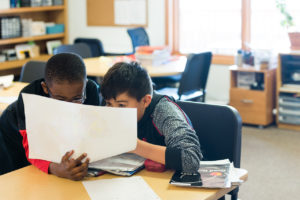 Most of the work they do is with concrete hands-on materials requiring movement. Upper elementary classes, in general, are quieter because they are refining their social skills and gradually giving up the concrete materials and moving into abstraction. Lower elementary is characterized by movement and noisier collaboration while upper elementary students are involved in pencil and paper tasks. Montessori’s “Planes of Development” diagram illustrates this phenomenon, something she observed in children all over the world, in every socio-economic strata, in every classroom. The first sub-plane of the six-year cycle is one of intense activity while the second sub-plane is a time for refining concepts and is calmer, one for refection.
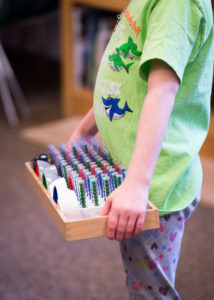 During the three-hour work cycle, students record their work in a diary or check off tasks in a work plan. The ebb and flow of classroom life varies from day to day, The students have access to the library located in the Phoenix building, the staff in the classroom who act as guides and the campus to further their lessons.
At the end of the cycle, the lower elementary students complete their diary or plan, recording the last bit of work accomplished for the morning. The students who are responsible setting up the lunch buffet, while the rest of the class clean their tables and put away their work. In the lower elementary students prepare for lunch, but in the upper elementary, students go outside for a 45-minute recess followed by lunch. The recess time is staggered with the upper elementary going outside first followed by the lower elementary 45 minutes later. Once the lower elementary students finish lunch and clean up the classroom, they go outside for their 45-minute recess.
In the interim between lunch and outside time, the students who are not involved in jobs get out a book for silent reading. Studies have shown that uninterrupted sustained silent reading is one of the best ways to develop good reading skills. In the afternoon, another two-hour uninterrupted work cycle begins with the same procedure as the morning.
Once a week during the day…
- The students conference with the teacher. All the week’s work is brought to the teacher along with the student’s work diary or plan. A number of strategies are used to guide the student in his work. A notebook with the goals and objectives of the public school at each grade level is sometimes used to show the student what the expectations would be if he were in a traditional classroom. Most often the notebook serves as a baseline. Occasionally a student will require more frequent conferencing, especially if the student is new, or has been in a 59 ELEMENTARY DAY traditional classroom. The conference is a time to evaluate the students work choices, the quality and quantity of their work and the goals for the coming week.
Once a week in the afternoon…
- The lower elementary students participate in Orff music in small groups, while the upper elementary students go to choral music.
- The class has a meeting to discuss issues which involve the immediate classroom community, but may also involve all school, campus, city or global issues as well.
- Students have an opportunity to present a finished work to the class. Presentations are an outgrowth of lessons and may include anything from a math presentation to producing a play. Sometimes students present a group research project to the class.
Photos courtesy of Leilani Tuttle, 7th Sister Photography.
A Day in the Life of a Raintree Erdkinder Student
As the day begins, adolescents may arrive as early as (7:30-8:15 AM) to assist in the set-up of the environment spaces, engage in outside work, and to prepare themselves for the day.
By 8:15, everyone should arrive, greet the guides, visit with friends, and gather materials for their morning schedule.
At 8:30, adolescent-led morning announcements begin. Attendance is taken, personal goals are shared, and special announcements are made.
The Erdkinder morning:
Spanish
The study and fluency of more than one language in today’s society is paramount. Students in our program will study Spanish. This language is one of the most common languages spoken in the world. It also offers the students a window back to the grammar of English. Spanish provides students a useful tool to engage with the world around them and to perhaps one day travel to both distant and nearby places where the language is spoken. Utilizing a direct method, the students speak immediately. Over the course of their time in Erdkinder they will develop a foreign language foundation that serves their educational pursuits into the future.
Mathematics
The adolescents begin where they left off at the end of the 6th year, moving into the study of pre-algebra, algebra and beyond. Lessons are presented, at times using concrete materials. Students practice with the work and materials to solve problems and apply the concepts to real life projects. The approach is evaluative and diagnostic.
Electives give each student the opportunity to individualize their schedules and pursue their own unique academic interests. During Electives time each week, students may be working on a writing assignment, honing their critical thinking skills with current events, attending a group class about a particular topic, or doing some other work they have discussed with their advisor. Potential electives may include writing, current events, debate, drama, finance, poetry, coding, cooking, and independent art projects as well as other independent studies.
Most days of the week, students have a chance to go outside for recess before lunch begins.
At 11:15 every day lunch is set up. Once lunch is finished and cleaned up, students move on to the afternoon schedule.
At 12:30 we begin the Study and Work Period.
According to Montessori, work on the land is a “limitless field for scientific and historic studies.” The Erdkinder plan for Study and Work is an uninterrupted work period for the adolescents to study the sciences, humanities and work toward projects within the model of production and exchange. Adolescents are given key lessons that serve to reveal the scope of the units they will engage in through group or individual work.
Humanities
In order to delve deeper into historical time periods adolescents will read more about a specific topic of interest, debate with classmates, conduct a library or study the art, music, and literature of that time in history. To demonstrate students’ understanding and mastery of the time and place studied they will have the opportunity for written assignments, oral presentations, or creative expression. Units aim to develop gratitude and faith in the general progress of humanity. Our purpose is to impart upon students the belief that every individual has the potential to contribute to the greater good of society.
Science
Observation is a critical part of Montessori education. Maria Montessori asked that teachers become joyful observers. Adolescents practice observation within the study of science through readings, lectures, science labs and other activities. Twice a year students take a deeper dive into the scientific method and the role of observations in that method. Science is closely tied to production and exchange and they will naturally become integrated. Students working in the greenhouse may use the scientific method in plant experiments or they may learn about photosynthesis while gardening, or anatomy and genetics through work with the chickens.
Production and Exchange
Projects center around the development of a microeconomy, such as raising chickens and marketing their eggs. First, a task or a challenge is identified from the land or the community. The group could decide, for example, to meet a need of the community through providing baked goods for a school event. Next, the students decide what they need to know and what they need to do in order to accomplish the task or solve the problem. Throughout the process they work as a group to acquire the knowledge and proficiency necessary to accomplish the task. Key lessons are given by the teacher and other community members to build knowledge and to experience roles within society.
Wednesdays are dedicated to Self Expression, Council Meeting, and Community Work (both on and off campus).
Self Expression
Adolescents have a great need for self-creation, deep friendships, and love which can be expressed through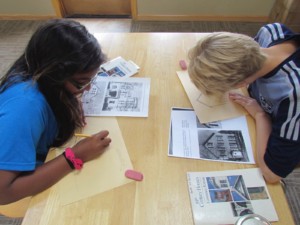 the arts. The nature of the arts is to wed the emotional and the intellectual into unique, original expression. Art (in any form) has dual value: it is both a powerful expression of the inner self and a profoundly effective avenue for connecting one human being to another. Physical expression gives our students a much-needed physical outlet, in the form of practice and exercise in various sports and activities.
Literature Seminar
Groups form quarterly and meet weekly to discuss the assigned reading. Seminar is an important process to the Erdkinder and is used as a structure to attend to a variety of topics.
Council Meeting
Students have a Council Meeting in the afternoon to report on our various microeconomies, share information about the week, and make plans for the following week. Issues that need the group’s input are discussed.
Community Work is also important to us. A list of things that need to be done is compiled by the group throughout the week. These items are then divided among the class and our work time begins. The students may perform community service jobs on- and off-campus.
After classroom jobs are done, the students head to Advisory Circle. At the beginning of their 7th year, students are assigned to one teacher who will be their advisor throughout the two years of our program. During Advisory Circle students update their planners, share their progress on their goals, and work on assignments.